About Me

Showing posts with label Bank of America. Show all posts

Friday, December 30, 2011

The Geezer Bandit: Back for More

Real Geezer or Real Silicone? The question on everyone's mind.


I've noticed a significant uptick in pageloads for the post I did on the Geezer Bandit several months ago. I'm suddenly getting a lot of hits from Europe, not unusual in itself but this is the first time I've had a lot of foreign activity on the Geezer interview. I figured something must have happened in the news to trigger these hits, and sure enough the Geezer has hit three more banks since my post. For some reason the story has gotten a lot of play in the European press.
The week before Christmas authorities released a security tape of a man they say is the Geezer Bandit leaving a Bank of America branch in San Luis Obispo, California. The dye pack that the teller slipped him along with the money explodes in the parking lot. You can see the Geezer trying to recover some of his stuff before he hightails it out of there. This happened on December 2. It was the Geezer's last bank job...so far anyway. Presumably he is recovering from the burns he got from the explosion and busy scrubbing the red dye off his skin, which could take weeks.
According to authorities the video further demonstrates that the Geezer Bandit may not be a geezer at all, but rather a much younger person, one capable of sprinting through a parking lot without a cane or a motorized scooter. They are now canvassing all the latex mask makers in the southern California area looking for their customers who may have purchased a mask called 'The Elder'.
All this is very discouraging to me because I have been following the Geezer's career with an eye to developing a 'Plan B' for my forced retirement. Let's face it, it's hard to make ends meet when the end of the income stream comes way before the end of the expenses. I figured this for the reason the Geezer embarked on a life of crime. Of course I was also thinking that the Geezer was, like me, an actual Geezer. Being a Geezer would explain a lot—everything in fact except the sprinting.
Robbing banks has a lot to recommend it for an elderly person with limited resources. It's easy to do. It doesn't require any special skills beyond a level head and a respectable 'skunk eye', both of which come quite naturally to a person of a certain age. Intimidating young people is fun. Knocking over banks seems an awful lot like justice. Getting caught is just like icing on the cake—free room and board, free medical care, a built-in excuse to get out of every disagreeable social and familial obligation for years to come, and, perhaps most important, even in prison no one wants to have sex with an old guy. This is all way better than my current retirement plan, and not least because no shifty Wall Street derivatives trader is likely to take it away from me.
Now I'm left wondering if all this is just a pipe dream. I mean, if the Geezer's a young guy with broken-field running ability and a latex mask, maybe this scheme is going to be harder than I originally thought. There are unforeseen (by me at any rate) barriers to entry. First off, the 'Elder' mask that the FBI thinks the bandit is using is listed on eBay at$1,799.99, buy it now. Second, a 9 millimeter Glock will set you back about $450, depending. I don't know how much ammo costs, but realistically you probably don't need any. Other supplies—day planner, paper sack, pad of paper and pencil for note writing—are going to set you back another $20-30. The fact is that I can't afford to get into a life of crime unless I get a job first. Well...that just sucks.
Then of course there's the sprinting. I can't do sprinting anymore. I can't even walk fast enough to please my dogs. You can ask them. They spend an incredible amount of time on our walks turning around to see what's holding me up. Sometimes they have such pained expressions on their faces that I am tempted to drop their leashes and hide in the bushes to spare them any further embarrassment. Sure, they're greyhounds, but really? I feed them. You'd think they'd cut me a little slack.
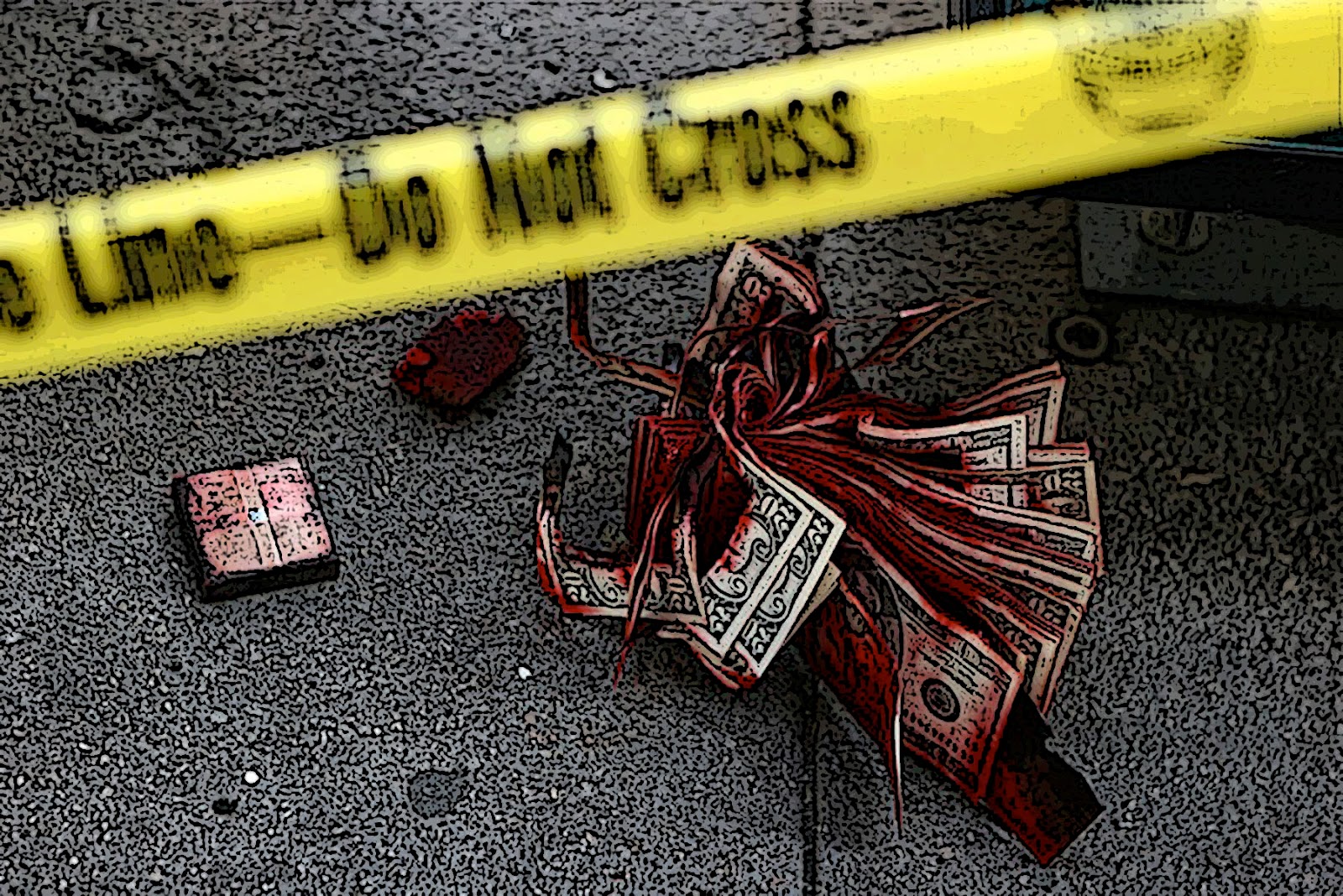
Exploding money...not unlike the disposition of my former retirement account...thank you very much.


Last is the problem of those pesky dye packs. Dye packs are terrifically effective for banks. They are said to be responsible for the recovery of some $20 million in stolen money and the apprehension of 2,500 bank robbers. Naturally, what's good for the banks is a problem for would be bank robbers. You could say it's an occupational hazard, but I think it's even worse than that. When a dye pack goes off in your paper bag full of loot you get fairly severely burned. Your clothes, your skin, and your money—the money that doesn't get burned up in the explosion—are stained bright red. Permanently. So your plans are foiled, you're marked for life, and you're injured. This just doesn't add up to a very good day at the office. I've had worse, but I'm not working any more. I like to think those days are behind me.
Personally I blame slip-shod customer service. I know the Geezer Bandit asked the teller, 'pretty please', to not slip a dye pack into his sack. He added what you'd think would be sufficient incentive by waving the Glock in her face. She gave it to him anyway. Modern tellers are just like every other person in the retail trades when it comes to executing the customer's wishes, especially if the customer is an elderly person. They can't pay attention long enough to get the simplest requests right. Most of us have just given up expecting what we asked for first time around. Who doesn't check inside the bag before they leave the drive-up window at McDonalds? No one is who. We all know better.
Not so easy for the Geezer Bandit though. The dye packs are disguised to look like regular money. In fact they are regular money—mostly. The receiver, trigger, dye and explosives are concealed in a stack of real currency. The banks don't mind blowing up a thousand dollars worth of twenties to stop a felon in his tracks. They've got plenty more where that came from. They get it out of their bailout funds, or take it from the rest of us in the form of new 'fees'. Sure.
Long story short, the Geezer couldn't just open his bag and look to see if the teller got his order right. He was in a hurry after all. He had places to be. He had to depend on the teller to be just a little bit brighter than your average counter help. He had to depend on the same level of customer service that he'd come to expect from Bank of America. Oh wait...Bank of America you say? Never mind.

Wednesday, October 5, 2011

MORE CONVERSATIONS WITH BEAN: Inbreeding the Banks


We've had our greyhound, Bean, for a year now. He's adapting well to life off the track, and he seems happy to have traded his racing days for a life of reflection. Every day he grows in wisdom and grace. He is a good dog, eager to please and quick to learn. We have begun to engage one another in conversation with some frequency. Here is one such exchange.
ME: Yes I did, Bean. Very interesting, don't you think?
BEAN: Interesting?! Frightening is what it is.
ME: How so?
BEAN: I've been watching this for a long time, ever since the news started talking about banks being too big to fail.
ME: And?
BEAN: Seems like merging is the wrong way to go about fixing the problem.
ME: You make a good point. If they're already too big, mergers just make them bigger.
BEAN: Yeah, but that's not the half of it. Think what's involved in the merger. You got a bad bank, full up with toxic assets, about to go under, and you merge it with another bank where all the same problems haven't come to light yet. You haven't solved anything. I mean, you palm Merril and Countrywide off on Bank of America, Wachovia off on Wells Fargo, Bear Sterns and Washington Mutual off on JP Morgan, you just made yourself a ticking time bomb. There are only four commercial banks left at the top. You're running out of places to bury the crap, if you know what I mean.
ME: You seem to have a pretty good handle on this for a dog.
BEAN: Well it's not exactly rocket science.
ME: A lot of people find this all very complicated.
BEAN: That's because they don't know how to think like dogs. Look at it like this. Suppose you had a really bad pit bull. He's aggressive, unmanageable, and anti-social. He's already done serious injury to a lot of innocent bystanders. What do you do with a dog like that? Do you neuter him? Rehabilitate him? Put him down? ...Or do you breed him to a bigger, stronger dog?  

Wednesday, August 18, 2010

Day 304 – Punters and Touts

Shame on us if we don’t stop the banks from continuing to fleece the country. They will be happy to blame someone else for the problems they created. In fact they’ve already done it. Do Bank of America or Citibank or JP Morgan or Goldman Sachs take any responsibility for the financial crisis? Do they think the Great Recession has anything to do with predatory lending policies and profiteering on unregulated derivatives, or do they want to lay it all at the feet of people who defaulted on their mortgages? 
There is no way that the threat of foreclosures on subprime loans brought the global financial system to its knees. The math doesn’t work. If all the subprime loans that are going to go bad went bad on the same day, the carnage still wouldn’t add up to what we got. What we got was a ridiculous multiple of the actual problem. And the reason we got a ridiculous multiple is the extent to which the banks leveraged their own folly.
Of this amount there was still some residual value in the underlying residential real estate. Average home prices had declined about 20% by that time. If you consider that the homes with delinquent mortgages were probably in worse shape than the average home, the value lost might have been as much as 40%. So the actual losses on mortgages in default in August of 2008 was something like $400 billion. How did this amount devastate the nation’s economy and send our largest banks into a tailspin?
The answer is twofold—leverage and speculation. The five major investment banks (Bear Stearns, Merrill Lynch, Morgan Stanley, JP Morgan, Lehman Bros. and Goldman Sachs) were leveraged between 25- and 32-to-one at the end of 2007. That means for every dollar of assets they had $32 dollars of debt. They were at the limit of their capital requirements, so their leverage played heavily in determining their soundness. Because of the leverage, if a bank had a million dollars of losses in their loan portfolio and took the loss—that is marked their portfolio down to its realizable value—it would have to come up with $25 to $32 million of additional capital. As you can imagine, this is a pretty scary place to be. This is why no one wanted to write their assets down. This is why they invented accounting chicanery and subterfuge to get the bad assets off their books at full value. At this point, not that I would suggest this is what happened, even fraud would have seemed a better alternative to telling the truth. The consequences certainly would have been less onerous—a few hundred million in fines and sanctions against losing the company entirely.
Speculation just made the problem worse. While there were $10 trillion in outstanding U.S. residential mortgages in 2008, there were $47 trillion in nominal value of credit default swaps circulating in the largely unregulated over-the-counter derivatives market. No one really knew how much was outstanding because the market was unregulated. The market was unregulated because Alan Greenspan, Bob Rubin, and Larry Summers decided to keep it unregulated back in the late 90s. Not only that...they saw to it that Brooksley Born, then head of the Commodities Futures Trading Commission, was silenced for daring to suggest that an unregulated market this size might turn out to be a problem.
Today Greenspan at least admits that this was a mistake. Rubin has denied any complicity in the decisions, and in a Herculean revision of history akin to cleaning out the Aegean stables, now claims that he always thought regulation of the derivatives market was a good idea.
Credit default swaps are like insurance contracts put into place to cover the losses should some mortgages stop performing. The derivatives protect the income stream of the investment in the mortgage. If the homeowner defaults, the derivative pays off. The investor, the organization in this case that bought a package of securitized mortgages, is whole. This is the ostensible purpose of CDS, but if this were their real application why in the world would we need $47 trillion of swap contracts to protect us from $400 billion in losses? That is 117.5 times more protection than was needed.
The speculative part of the problem comes in because, in the world of derivative contracts, you don’t have to own a mortgage to insure against mortgages defaulting. These things are traded in banks and brokerage houses, but they would be more at home in betting parlors. They are not investments. They are wagers.
Derivatives are gambling in its purest form. They are perfectly analogous to a pari-mutuel ticket on a horse race. When you bet on a horse race, you do not have a stake in the horse. You have no interest or participation at all in the horse racing industry. Your only interest is in the outcome of the races on which you have bought tickets. Derivatives are the same. You are betting on the outcome of an event. You don’t have to have a stake in the event other than your contract. You don’t care about the owner of the mortgage, or its originator, or the homeowner, or the value of the mortgaged property. You only care if the mortgage stays good or goes bad. One way you win. One way you lose. Whatever else happens is not your concern.
You can buy a contract on anything. This is what our august financial institutions were doing—gambling on outcomes in which they had no stake other than the outcome. Because the market was unregulated and thus hidden from scrutiny, no one had any idea how deeply the problem ran. The banks were betting against their bets against their bets against their bets that mortgages wouldn’t go bad.
Of course the problem was that If a bunch of mortgages went bad, the companies that sold the derivative contracts were going to have to pay off three and four times...or 10...or 117. No one was prepared to do that. No one could. There wasn’t enough real value in the system to allow that to happen. The whole thing was an enormous house of cards that spun off hundreds of millions of dollars of profits over a decade or so, but which was so fragile that it would all come tumbling down in the balmiest zephyr of ill wind. That’s why now we taxpayers are going to have to pay off the losses three times over before we’re out of the woods.
This is crazy. This kind of stuff is no longer about saving the financial system or shoring up the markets against unforeseen volatility. This is about a handful of guys that we trusted because they were supposed to be the smartest guys in the room betraying that trust and using their smarts, their cultural advantages, and their connections, to systematically strip us of the wealth many of us actually worked for…and they’re still at it.
The banks are still lobbying for less regulation, still trying to keep unfettered access to derivative plays, still anxious to package and sell collateralized debt obligations, and still especially vested in remaining too-big-to-fail because that takes all the risk out of the game for them. Staying too-big-to-fail insures that they will be bailed out by the taxpayers whenever their risk models fail. They reap huge profits on inordinate risk, and we back their play. Who wouldn’t want a piece of that action?